5 Hidden Features of the Creality Falcon A1 Pro Laser Engraver You Must Know About
Introduction
The Creality Falcon A1 Pro laser engraver is often talked about for its build quality and strong baseline performance, but buyers who only skim the spec sheet can miss capabilities that materially change daily use. Beyond power ratings and work area dimensions, a handful of nuanced features and workflow tweaks unlock better accuracy, faster throughput, and safer operation. This article explores five of those lesser-known capabilities, explains why they matter to real-world users, and includes a practical review, pros and cons, a comparison table, and a buying guide to help potential buyers decide if the Falcon A1 Pro fits their needs.
Why hidden features matter
For hobbyists, makers, and small-business owners, the true value of an engraver comes from how reliably it produces the intended result with minimal fiddling. Hidden or under-documented features often reduce setup time, improve repeatability, or enable new project types (for example, photographic engraving or rotary work) that buyers may not expect. Highlighting these features helps translate a spec sheet into tangible benefits: less waste, cleaner cuts, and faster time-to-finish.
Detailed product review and analysis
The Falcon A1 Pro presents as a well-rounded desktop laser engraver aimed at users who demand both engraving precision and reasonable cutting ability in a compact package. Build quality is generally robust with a rigid chassis that minimizes vibration during raster passes, which is immediately noticeable when doing fine halftone work. The unit's control surface and companion software are oriented toward quick job setup but also expose advanced settings for users who need more control—this duality is the source of several of the "hidden" features discussed below.
From a performance perspective, the Falcon A1 Pro performs well on common maker materials: hardwoods, acrylics, leather, paper/cardstock, and thin plywood. For small-batch production (gift tags, small signage, personalized accessories) it offers a productive balance of speed and detail. For buyers who prioritize industrial-level throughput or very deep cutting in thick hardwoods, a larger CO2 or fiber system would be more appropriate; nevertheless, the Falcon A1 Pro's precise beam and software options make it a versatile machine for many shops.
Build and ergonomics
The Falcon A1 Pro’s enclosure improves safety and helps control fumes for indoor use. Access points and the layout of the workbed are designed for quick loading and unloading, which owners appreciate when producing batches. The unit’s mounting points for optional attachments (rotary or air assist) are practical: they allow the machine to adapt to specialized tasks without time-consuming rework.
Software and connectivity
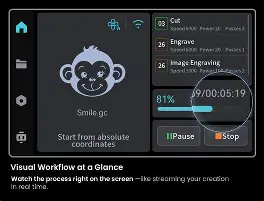
Creality’s software ecosystem for laser devices includes a desktop app and some on-device controls. The desktop workflow allows detailed parameter control and job previewing. Many users report that the accompanying firmware accepts industry-standard file types and that the device can also run jobs from a USB thumb drive or an on-device library, making it useful in environments without a permanent PC connection.
Safety and maintenance
Important but easily overlooked: interlocks, exhaust ports, and service access points. The Falcon A1 Pro includes standard safety interlocks and accessible air and exhaust ports. Routine maintenance—lens cleaning, air assist nozzle cleaning, and alignment checks—is straightforward and documented, but knowing where to check before a first project saves time and prevents common early mistakes that cause smoke marks or focus drift.
5 Hidden Features Explained
1. Precision camera-based material preview and alignment
Many users assume alignment is done purely by trial placement or by printing physical masking templates. The Falcon A1 Pro’s built-in camera (or camera support via the control software) offers a visual preview that overlays the design onto the live work area image. This feature allows precise placement of artwork on odd-shaped objects, ensures margins are respected, and reduces scraps when engraving pre-made items like cutting boards, phone cases, or pre-printed materials. For businesses doing personalized work, that can be the difference between five perfect pieces and five attempts with inconsistent results.
2. Smart focus and fast focal presets
Auto-focus and manual focal presets are often lumped together, but the practical advantage is the time savings during material changeover. The Falcon A1 Pro supports quick focal height presets and a fast-check mode that helps set the correct lens-to-material distance for both cutting and engraving passes. When switching from acrylic cutting to detailed wood engraving, users can switch presets in seconds instead of measuring and testing, which is especially valuable in batch workflows.
Shop the latest Electronics picks on Amazon.
Browse Now →3. Advanced pulse modulation and grayscale engraving modes
Beyond basic on/off power control, selectable pulse modulation or PWM-based grayscale modes enable photographic engraving and nuanced shading on materials like hardwoods and anodized metals. These modes allow the user to tune the effective energy delivered per dot, producing smoother gradients and more faithful image reproduction. For makers producing photorealistic portrait plaques or jewelry mockups, this feature elevates project quality significantly compared to machines limited to binary dot control.
4. Native support for rotary accessories and off-center fixtures
Rotary work is frequently an add-on that requires extensive setup. The Falcon A1 Pro’s firmware and software expose rotary-specific settings and off-center fixture support, so cylindrical items such as cups, rings, or rolling pins can be aligned and engraved with minimal manual calculations. Small businesses doing personalized drinkware or custom rolling pins will find this reduces setup time and increases throughput compared with adapters that require external math to convert artwork to cylindrical coordinates.
5. Job queuing and offline job storage
For makers who don’t want the computer tethered to the machine during long runs, the Falcon A1 Pro’s ability to store multiple jobs locally and queue them from the on-device interface is a major workflow improvement. This makes it possible to prepare several files in sequence and run them unattended (with proper ventilation and monitoring), which turns the engraver into a reliable production asset rather than a single-task bench tool.
Pros & Cons
- Pros:
- Accurate camera-assisted alignment for complex workpieces and pre-printed materials
- Fast focus presets reduce setup time when changing materials
- Advanced pulse modulation enables high-quality photographic engraving
- Support for rotary accessories expands usable project types
- Local job queuing and offline storage improve production workflow
- Cons:
- Ventilation and fume extraction are required for many materials—additional equipment may be needed
- Advanced features have a learning curve for users new to grayscale engraving or rotary work
- For deep cuts in thick hardwoods or metals, larger or different laser types perform better
- Firmware and software updates may change UI locations for hidden features, requiring relearning after upgrades
Comparison Table: Falcon A1 Pro vs. Typical Alternatives
| Feature | Entry-level Diode Engraver | Creality Falcon A1 Pro | Mid-range CO2 Engraver |
|---|---|---|---|
| Best for | Hobby projects, low power marking | Precision engraving, small batch cutting, photographic engraving with presets | Larger signage, thicker material cutting, industrial marking |
| Hidden workflow features | Limited | Camera alignment, focus presets, PWM grayscale, rotary support, queued jobs | Often includes rotary and strong cutting power; camera features vary |
| Material flexibility | Wood, leather, some plastics (thin) | Wood, acrylic, leather, coated metals (marking), fabric, thin plywood | Broad—wood, thick acrylic, leather, glass, coated metals |
| Ventilation needs | High for some plastics; variable | High for plastics and treated materials; integrated exhaust ports helpful | High; often requires professional extraction |
| Ease of use | Very easy for simple jobs | Moderate—many automated helpers but advanced options exist | Moderate to advanced; more setup for industrial work |
Real-world use cases
The Falcon A1 Pro fits multiple user profiles:
- Personalization and small businesses: Rapidly producing personalized gifts — engraved cutting boards, custom coasters, or leather goods — where camera alignment reduces rejects and rotary support expands product range to drinkware.
- Photographic engraving: Reproducing portraits on wooden plaques or photo panels using the grayscale mode for smoother tonal transitions.
- Prototyping and marking: Rapid marking and labeling of enclosures, prototypes, and tools where quick changeovers and precise placement matter.
- Educational makerspaces: Teaching design-to-production workflows with a machine that balances safety features and accessible advanced options for students.
Buying guide: What to check before purchasing
When evaluating the Falcon A1 Pro or a comparable unit, consider the following practical points that often determine long-term satisfaction.
1. Workspace size versus project needs
Ensure the available bed dimensions match the typical size of the projects. For small tokens and jewelry, desktop units are fine; for larger signage or multiple-part batches, account for whether the machine can handle required dimensions or whether multiple passes are needed.
2. Software capability and file formats
Confirm support for common vector and raster formats used in the buyer’s workflow (SVG, DXF, PNG, JPG). Evaluate whether the provided software exposes advanced parameters (pulse modulation, dithering, rotary mode) and whether presets can be saved and exported for reproducible jobs.
3. Ventilation and safety requirements
Laser work produces fumes and particulates. Confirm the machine’s exhaust port compatibility and plan for an extractor or filtered ventilation suitable for the materials intended. Verify the included safety features—lid interlock, emergency stop, and firmware-level protections—meet shop or classroom policies.
Looking for the best Electronics deals on Amazon?
Browse Now →4. Material compatibility and power
Match the laser’s effective power and beam quality to intended materials. Buyers who want to frequently cut thick hardwoods or non-ferrous metals need a different class of laser; those focused on detailed engraving and thin material cutting will find a compact diode unit appropriate.
5. Upgradability and accessories
Check what accessories are officially supported: rotary adapters, air assist, different lenses, and upgrade paths for firmware. Official accessory support simplifies setup and reduces trial-and-error when adding capabilities.
6. Community support and documentation
A strong user community shortens the learning curve. Look for active forums, clear official documentation, and readily available guides for the hidden features described earlier (camera alignment, grayscale settings, rotary setups). These resources speed up troubleshooting and optimization.
7. Warranty and service
Confirm warranty terms and how spare parts or service are handled. Laser modules, lenses, and belts are wear items—availability and price of replacements impact long-term cost of ownership.
Optimizing the Falcon A1 Pro for best results
Some practical tips for getting the most from the hidden features:
- Use the camera preview for every new stock type — even small differences in grain or pre-printed guides change alignment needs.
- Create and save focus presets for common materials and thicknesses so changeover is repeatable.
- Experiment with different dithering algorithms and pulse widths when attempting photographic engraving to find the sweet spot for the chosen material.
- When using rotary accessories, do a single test pass on a disposable item to verify circumference mapping before committing to a full batch.
- Keep a simple maintenance checklist—lens cleaning, nozzle check for air assist, and belt tension—to maintain beam quality and accuracy.
Conclusion
The Creality Falcon A1 Pro laser engraver offers more than first impressions suggest. Its camera-assisted alignment, fast focus presets, advanced modulation for grayscale engraving, rotary support, and local job queuing are features that change how people use the machine day-to-day. For hobbyists who want cleaner results, small-business owners needing repeatable production, or makers exploring photographic engraving and cylindrical work, these capabilities make the Falcon A1 Pro a versatile and practical tool. Buyers should weigh ventilation needs, software support, and accessory availability against their intended projects, but for many users the machine’s hidden features deliver measurable improvements in speed, quality, and flexibility.